





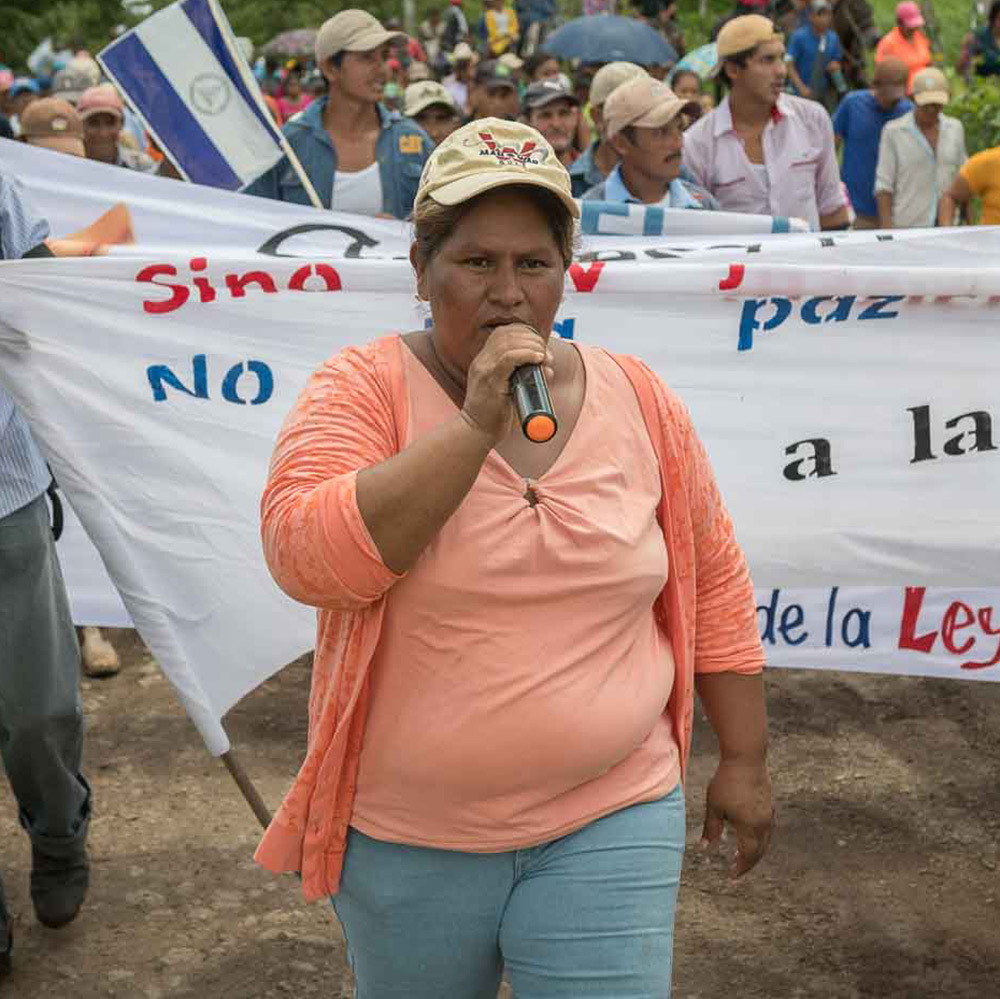
Francisca Ramirez
-
 Nicaragua
 -
 Environment
Francisca Ramirez is a Nicaraguan environmental, land and peasant’s rights activist from the community of La Fonseca, Nueva Guinea on the Caribbean coast. She has been named as one of the 60 most influential people in Central America by Forbes Mexico. Francisca founded the Consejo por la Defensa de la Tierra, Lago Soberania (Council for the Defense of the land, lake, and sovereignty). Nicaragua is regarded as one of the most dangerous and threatening countries with respect to land rights. Francisca and her family have received numerous death threats from the government in attempts to silence her activism. Ramirez has summarily declined several high-priced buyouts of her land and other hush money to cease her efforts in activism.
Ramirez has been critical of government failings in infrastructure, such as roads, that have severe economic repercussions on poor farming communities. Francisca is a vital part of educating farming communities and other working-class groups of their rights across various regions of Nicaragua. In 2014 she began her fight against a controversial law that was signed by the government allowing HKND Group, a Chinese developer, to build a shipping canal through the country. The intercontinental shipping canal would displace a considerable amount of farming and peasant families, forcing them from to give up long-held lands and resettle elsewhere.
On April 20, 2018, Ramírez and several other leaders of the peasant’s rights movement declared support for the grassroots protests taking place throughout the nation and called for a general strike. The strike and resulting protests became one of the deadliest scenes to affect the country since the Nicaraguan revolution. Following the violence, Ramirez went out for a second demonstration, stating “it is time for (President) Daniel Ortega to understand that he cannot continue doing whatever he wants with this country…It has been enough. We want peace but with justice for the murders…”
Nicaragua
-

- Flag

-

- Population
- 5,966,798
-

- Capital
- Managua
-

- GDP (PPP)
- $5,280
-

- Founded
- September 15, 1821
-

- Total Area
- 130,375 km2 (97th)
-

- Demonym
- Nicaraguan
-

- Government
- Unitary presidential consitutional republic



Artwork
This portrait of Francisca Ramirez is superimposed on a glazed silhouette of Nicaragua. Leaning into traditional Nicaraguan ceramics, her painted image represents her environmental activism efforts, where the non-glazed portion symbolizes the government’s pressure on her community’s land.
Francisca Ramirez is a Nicaraguan environmental, land and peasant’s rights activist from the community of La Fonseca, Nueva Guinea on the Caribbean coast. She has been named as one of the 60 most influential people in Central America by Forbes Mexico. Francisca founded the Consejo por la Defensa de la Tierra, Lago Soberania (Council for the Defense of the land, lake, and sovereignty). Nicaragua is regarded as one of the most dangerous and threatening countries with respect to land rights. Francisca and her family have received numerous death threats from the government in attempts to silence her activism. Ramirez has summarily declined several high-priced buyouts of her land and other hush money to cease her efforts in activism.
Ramirez has been critical of government failings in infrastructure, such as roads, that have severe economic repercussions on poor farming communities. Francisca is a vital part of educating farming communities and other working-class groups of their rights across various regions of Nicaragua. In 2014 she began her fight against a controversial law that was signed by the government allowing HKND Group, a Chinese developer, to build a shipping canal through the country. The intercontinental shipping canal would displace a considerable amount of farming and peasant families, forcing them from to give up long-held lands and resettle elsewhere.
On April 20, 2018, Ramírez and several other leaders of the peasant’s rights movement declared support for the grassroots protests taking place throughout the nation and called for a general strike. The strike and resulting protests became one of the deadliest scenes to affect the country since the Nicaraguan revolution. Following the violence, Ramirez went out for a second demonstration, stating “it is time for (President) Daniel Ortega to understand that he cannot continue doing whatever he wants with this country…It has been enough. We want peace but with justice for the murders…”